
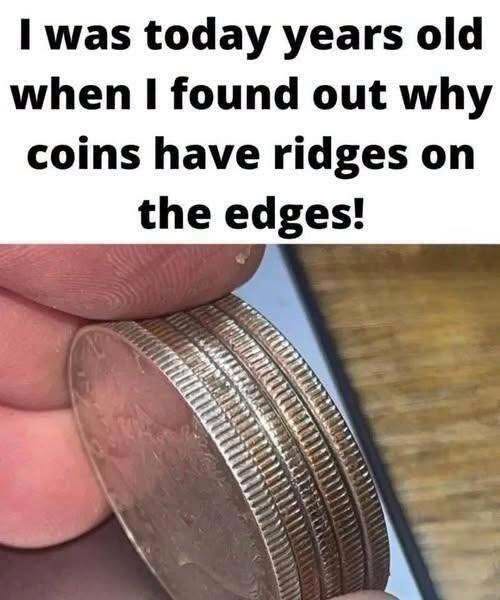
Run your finger along the edge of a quarter or dime, and you’ll notice a series of tiny, evenly spaced grooves wrapping around the coin. Most people never give them a second thought, assuming they’re simply decorative details or part of the minting process. In reality, those small ridges tell the story of one of history’s earliest anti-counterfeiting innovations. They were created not to make coins look more attractive, but to protect entire economies from fraud, theft, and the gradual erosion of public trust in money itself.
To understand why these ridges exist, it’s necessary to travel back several centuries to a time when coins were far more than symbols of purchasing power. Throughout the 1600s and early 1700s, many coins circulating across Europe were struck from genuine gold and silver. Their value was determined largely by the amount of precious metal they contained. A gold coin was valuable because it actually held gold, and a silver coin carried worth because of its silver content. While this system worked well in theory, it also created an opportunity for dishonest individuals to profit without immediately attracting attention.
Criminals discovered a simple but highly effective scheme known as coin clipping. Using small cutting tools or sharp blades, they carefully shaved tiny slivers of gold or silver from the edges of circulating coins. Each individual coin lost only a minute amount of metal—so little that the difference often went unnoticed during everyday transactions. However, when thousands of coins were clipped over time, the accumulated precious metal became extremely valuable. Those tiny fragments could then be melted down and sold or used to produce counterfeit coins.
The clipped coins themselves continued circulating as though nothing had happened. Because there were few practical ways for ordinary merchants or customers to weigh every coin they received, slightly underweight coins often passed from hand to hand unnoticed. Gradually, more and more precious metal disappeared from circulation while the coins continued carrying the same face value. This imbalance weakened confidence in the currency, disrupted trade, and created growing uncertainty about whether the money people accepted truly contained the value it claimed to represent.
Governments eventually realized that the greatest weakness was not simply the existence of dishonest people but the design of the coins themselves. Smooth-edged coins made clipping easy because removing a thin layer of metal left little visible evidence. Authorities needed a way to ensure that any attempt to alter a coin would immediately become obvious.
One of the most influential figures in solving this problem was Sir Isaac Newton. Although he is best remembered for his groundbreaking work in physics, mathematics, and astronomy, Newton also played a major role in England’s monetary system after being appointed Warden of the Royal Mint and later Master of the Mint. In these positions, he oversaw coin production, investigated counterfeiters, and introduced important reforms designed to restore confidence in the nation’s currency.
Applying the same logical thinking that defined his scientific work, Newton supported improvements to coin production that made tampering much easier to detect. Rather than leaving the edges smooth, mints began impressing them with evenly spaced grooves, a process known as reeding. This seemingly small design change had a powerful effect. If someone attempted to clip or shave even a small amount of metal from the edge, the carefully engraved pattern would immediately be interrupted. Missing or damaged grooves became clear visual and tactile evidence that the coin had been altered.
The introduction of reeded edges dramatically reduced the effectiveness of coin clipping. What had once been an almost invisible crime suddenly became much easier to detect. Merchants no longer needed to rely entirely on weighing every coin or trusting appearances alone. Simply inspecting the edge often revealed whether someone had attempted to remove precious metal.
Over time, reeded edges became standard on many coins around the world. Even after most nations abandoned precious-metal currencies in favor of modern coinage made from less valuable metals, the ridged design remained because it continued serving useful purposes beyond preventing clipping.
Today, coins such as United States quarters and dimes contain little or no precious metal compared with the coins of earlier centuries. Their value comes from government authority rather than the intrinsic worth of their metal content. Nevertheless, the ridged edges still contribute to modern security. Automated coin-counting machines, vending machines, parking meters, and other coin-operated equipment often analyze a combination of weight, size, electromagnetic characteristics, and edge patterns when verifying whether a coin is genuine. The distinctive grooves help machines distinguish authentic currency from counterfeit pieces or foreign coins with similar dimensions.
Reeded edges also improve accessibility for people with visual impairments. Differences in edge texture allow many individuals to identify coin denominations by touch alone. For example, in the United States, the dime and quarter both feature reeded edges, while the nickel has a smooth edge. These subtle distinctions make everyday transactions more convenient and allow many people to recognize coins without relying solely on sight.
Perhaps the most remarkable aspect of these tiny grooves is what they represent. They serve as a reminder that confidence in money has never existed automatically. Every feature of a coin—its size, weight, composition, inscriptions, images, and even the texture of its edge—has been carefully designed through centuries of experimentation, refinement, and lessons learned from past attempts at fraud. The ridges preserve the history of a time when the smallest physical detail could determine whether an entire monetary system remained trustworthy.
Although physical currency plays a smaller role today than it once did, with digital payments, online banking, and mobile transactions becoming increasingly common, coins continue carrying these historical design features. Every time someone handles a quarter or dime, they are unknowingly touching a solution developed centuries ago to solve a serious economic problem.
Those tiny grooves are far more than decorative lines pressed into metal. They are the legacy of a period when the value of money could literally be stolen one shaving at a time, and when careful engineering helped restore public confidence in everyday commerce. The next time you roll a coin between your fingers and feel those narrow ridges, remember that you are holding a piece of financial history—a simple yet ingenious security feature that has survived for generations and continues prote