
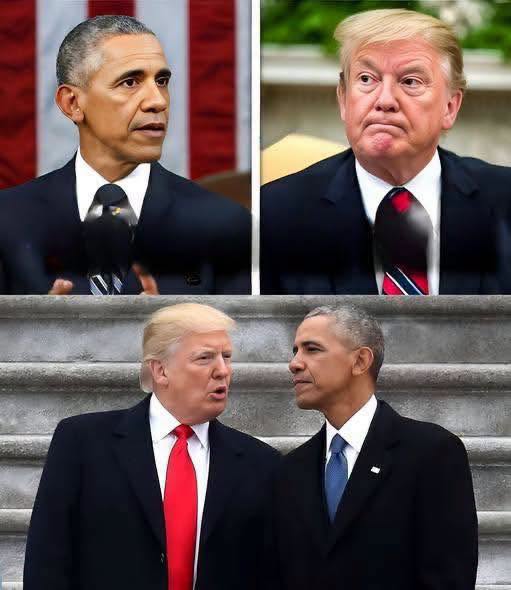
The instant the cameras captured it, the atmosphere shifted completely.
What had begun as a routine political discussion suddenly transformed into a tense and highly personal confrontation, with Donald Trump launching a direct and uncompromising attack on Barack Obama before a national audience. Within moments, clips of the exchange spread across social media, commentators rushed to interpret every word, and Americans once again found themselves divided over a single televised moment. What started as a scheduled appearance quickly became something far larger—a vivid demonstration of how modern politics often blurs the line between debate, entertainment, and spectacle.
As the conversation unfolded, attention drifted away from policy details and toward personality-driven conflict. Trump’s remarks were not framed as a disagreement over legislation or governance. Instead, they focused on Obama himself, his record, and his place in American political history. Supporters viewed the criticism as a long-overdue challenge to an influential former president, while opponents saw it as another example of personal attacks replacing substantive discussion. Either way, the confrontation immediately became the dominant story of the day.
The reaction online was swift and predictable. Within minutes, social media platforms filled with edited clips, viral captions, and competing interpretations. Every phrase was dissected, every facial expression analyzed, and every pause treated as evidence supporting one side or the other. People who had watched the exact same broadcast often emerged with entirely different conclusions. The exchange became less about what had actually happened and more about how different audiences chose to interpret it.
What made the moment particularly significant was not necessarily the content of the criticism itself, but the speed with which it was transformed into competing narratives. Supporters highlighted certain excerpts that reinforced their views, while critics circulated entirely different segments that painted a contrasting picture. Context often disappeared in the process, replaced by emotionally charged fragments designed to generate engagement, outrage, or affirmation.
Observers noted that the incident reflected a broader shift in political culture. Public discourse increasingly rewards moments that provoke strong reactions rather than those that encourage careful reflection. In an environment dominated by instant communication and viral content, dramatic confrontations often receive far more attention than detailed policy discussions. The result is a political landscape where visibility can matter as much as substance.
The exchange also underscored how deeply polarized the country remains. Rather than serving as a shared national experience, major political events now tend to reinforce existing beliefs. People frequently approach such moments not as neutral observers but as participants already aligned with one side of a broader cultural and political conflict. The confrontation between Trump and Obama became another example of this pattern, with each audience filtering events through its own assumptions and expectations.
Beyond the immediate controversy, the episode highlighted the growing role of performance in modern politics. Public figures are increasingly evaluated not only on the strength of their arguments but also on their ability to command attention. A memorable line, a dramatic confrontation, or a viral clip can dominate headlines for days, sometimes overshadowing the underlying issues that originally brought leaders together.
Critics argue that this trend weakens public understanding by prioritizing emotional impact over factual analysis. Supporters counter that forceful communication is sometimes necessary to cut through political messaging and expose what they view as uncomfortable truths. Regardless of where one stands, there is little doubt that moments like this now shape political conversations far beyond the confines of the original broadcast.
In the end, the confrontation may be remembered less for any specific accusation or rebuttal and more for what it revealed about the current state of public discourse. It demonstrated how quickly a single televised exchange can fracture into countless competing versions of reality, each amplified by algorithms, commentators, and partisan communities.
Perhaps the most enduring lesson is that modern political history is increasingly written in real time. Before analysts can fully examine an event, millions of people have already interpreted it, shared it, and woven it into larger narratives about power, identity, and loyalty. The exchange between Trump and Obama did not simply generate headlines—it became a reflection of an era in which attention moves faster than understanding, and where the loudest moments often leave the deepest mark on public memory.