
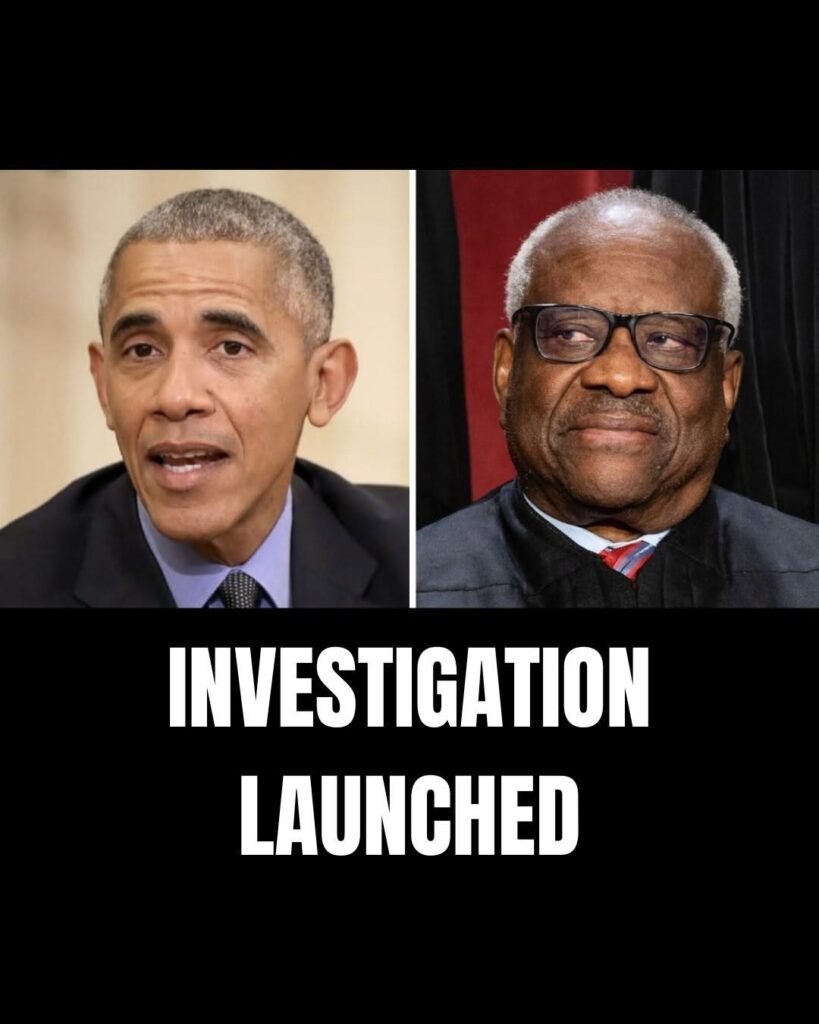
Recent online discussions have reignited interest in legal and political controversies involving former President Barack Obama and former Supreme Court Justice Clarence Thomas. Social media posts claiming that a new investigation has been launched have circulated widely, prompting questions about the relationship between politics, the judiciary, and public accountability in the United States.
While the details behind many viral claims remain unclear, the conversation has once again highlighted the long-standing debates surrounding the role of Supreme Court justices, ethical standards, and political influence within American institutions.
A History of Political Tension
Throughout his presidency, Barack Obama frequently found himself at the center of major constitutional debates involving the Supreme Court. Landmark rulings on healthcare, immigration, voting rights, and executive authority often placed the administration under intense scrutiny.
At the same time, Justice Clarence Thomas emerged as one of the Court’s most influential conservative voices. His judicial philosophy and opinions on constitutional interpretation have made him a significant figure in American legal history, attracting both strong support and sharp criticism.
Questions About Judicial Ethics
In recent years, discussions about judicial ethics and transparency have become increasingly prominent. Lawmakers, legal scholars, and advocacy groups have debated whether additional oversight measures should apply to Supreme Court justices.
Supporters of reform argue that greater transparency can strengthen public confidence in the judiciary. Opponents caution that excessive political pressure could threaten judicial independence, a cornerstone of the American constitutional system.
These debates have fueled ongoing conversations about how the nation’s highest court should balance accountability with independence.
Public Interest Remains High
Whenever prominent political and judicial figures become linked in public discussions, media attention often follows. Analysts note that Americans remain deeply interested in issues involving constitutional law, government oversight, and the separation of powers.
The combination of a former president and a Supreme Court justice naturally attracts widespread public attention, particularly when claims of investigations or legal reviews begin circulating online.
Experts Urge Verification
Legal experts caution that viral social media graphics and headlines frequently oversimplify complex issues. They recommend relying on official statements, court documents, and credible reporting before drawing conclusions about any alleged investigation.
Many high-profile claims spread rapidly online before facts are fully established, making careful verification especially important.
Broader Implications
The renewed attention surrounding Obama and Thomas reflects broader questions about trust in public institutions. Debates over ethics, accountability, and constitutional authority are likely to remain central topics in American political life for years to come.
As discussions continue, observers emphasize that transparency, due process, and factual reporting remain essential to maintaining confidence in democratic institutions. Whatever developments may emerge, the story underscores the enduring importance of the relationship between politics, law, and public accountability in the United States.